How 2% Moisture or 10 °C Temperature Shifts Honey Viscosity 4×
Honey viscosity is extraordinarily sensitive to both water content (16.5% heather/desert honey is vastly stiffer than 19.5% clover honey) and temperature. Grounded in honey line sizing and selection and honey viscosity and nozzle specs, use this lookup chart to prevent undersized nozzles that choke cycle times or oversized nozzles that drip.
Rule of thumb: nozzle outer diameter must leave >=3–4 mm radial air-vent clearance inside your smallest bottle neck so displaced air escapes without burping honey onto threads.
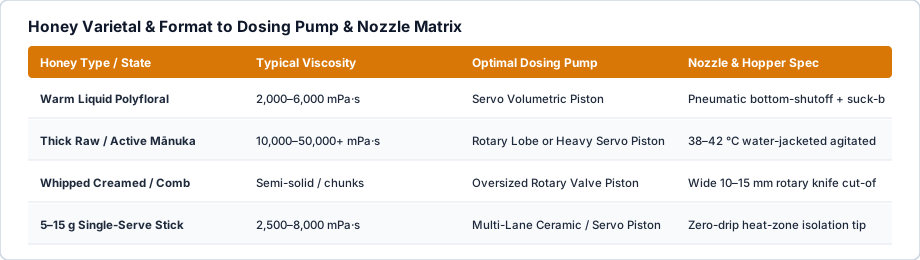
Honey Viscosity to Nozzle & Manifold Engineering Lookup
Recommended hardware pairing across five real-world honey rheology bands:
| Honey Condition & Temp | Dynamic Viscosity (mPa·s / cP) | Min Nozzle Bore (ID) | Hopper & Feed Spec | Best Dosing Valve |
|---|---|---|---|---|
| Liquid Floral @ 40 °C (18.5% H2O) | 1,800 – 3,500 cP | 6–10 mm (3–4 mm sticks) | Insulated / 40 °C water jacket | Bottom-shutoff PTFE stem + suck-back |
| Liquid Floral @ 22 °C (18% H2O) | 7,000 – 14,000 cP | 8–14 mm diving nozzle | DN50 short tri-clamp manifold | Servo piston + 3-way rotary plug |
| Low-Moisture 16.5% @ 25 °C | 18,000 – 35,000 cP | 12–18 mm wide bore | 38–40 °C jacketed scraper tank | Heavy-torque servo piston / lobe |
| Active Mānuka (Thixotropic) | 25,000 – 60,000+ cP | 12–20 mm positive cut | Low-shear agitator (<=35 °C) | Pressurized feed + rotary-valve piston |
| Whipped Creamed Honey (22 °C) | 40,000 – 90,000+ cP paste | 15–24 mm knife-edge | Auger/pressurized cone (unheated) | Wide-port rotary-shear piston |
See full varietal line designs in creamed and Mānuka honey filling lines.
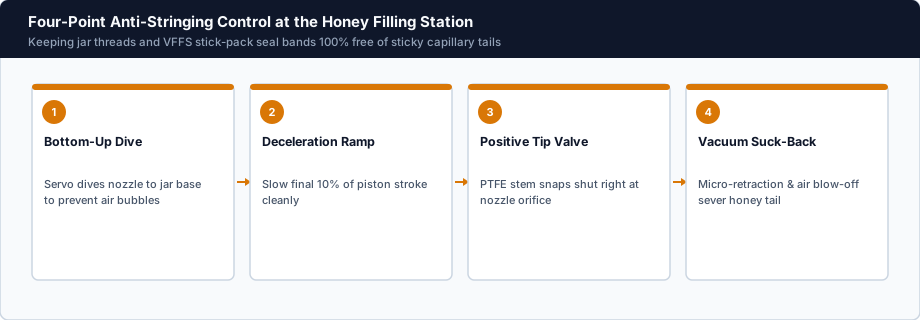
Honey Packaging Engineering Notes
- Measure Bottle Neck Finish ID—Not Cap Code: A ‘38-400’ PET squeeze neck has ~33–34 mm inner diameter, easily accepting a 14 mm OD diving nozzle; a narrow 24 mm neck limits nozzle OD to <=16 mm.
- Avoid Mesh Strainer Starvation on Suction Side: Always filter honey upstream of the buffer hopper—putting a fine mesh screen between hopper and piston suction causes instant cavitation.
- Verify HMF Safety Margin: Keep warm-water jacket supply strictly <=42–45 °C (never live steam!) so wall boundary layers never caramelize.
Match Your Jar Neck & Honey °Brix
Send your honey moisture %, fill temp, and bottle neck ID via Project Brief.
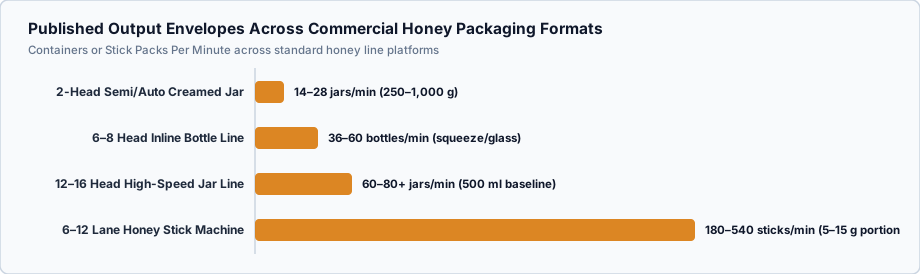
Explore related systems in Honey Packaging Lines, Viscosity & Anti-Drip Specs, or send your jar/stick specs via Project Brief.
Related Specifications
Further Reference
Request Project Configuration Review
Share layout constraints, architectural drawings, or throughput targets with Honey Packaging Line Technical Group.
Configure My Honey Line