How to Verify Drip-Free Viscous Accuracy Before Your Line Ships
Never sign off a honey line Factory Acceptance Test run on plain water! Grounded in honey line sizing and selection and honey viscosity and nozzle specs, insist on testing with 10,000–35,000 cP maltose syrup or actual honey inside your own shipped glass jars, PET squeeze bottles, or stick-pack laminate.
Equally important, verify warm-water Clean-in-Place (CIP) drainage so residual wash water never dilutes the next morning’s honey batch above 20% moisture.
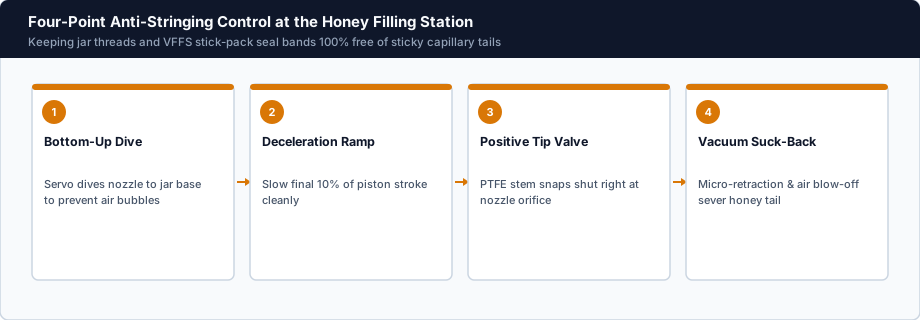
Five-Point Honey Line FAT & CIP Verification Protocol
Acceptance benchmarks for pre-shipment testing and daily plant sanitation:
| Test / Protocol | Procedure on Viscous Test Media | Pass Criterion |
|---|---|---|
| 1. 50-Jar Gravimetric Audit | Weigh 50 consecutive jars per head on 0.1 g scale | Within ±0.2%–0.5% of target net weight |
| 2. 100-Cycle Rim & String Check | Inspect 100 filled bottle necks under bright LED | Zero honey threads on threads, conveyer, or outer wall |
| 3. Closure Vacuum / Foil Audit | Vacuum gauge on glass lug; -0.06 MPa bath on foil/sticks | Safety button depressed; 100% leak-free foil/stick seals |
| 4. Bubble-Free Visual Check | Hold filled clear PET bears / hex jars against backlight | Smooth bottom-up fill free of trapped foam pockets |
| 5. Warm-Water CIP & Dry-Purge | Flush 55–65 °C water loop -> blow dry with filtered air | 100% residual water drained before reloading honey |
See factory build commitments on honey packaging machine manufacturer.
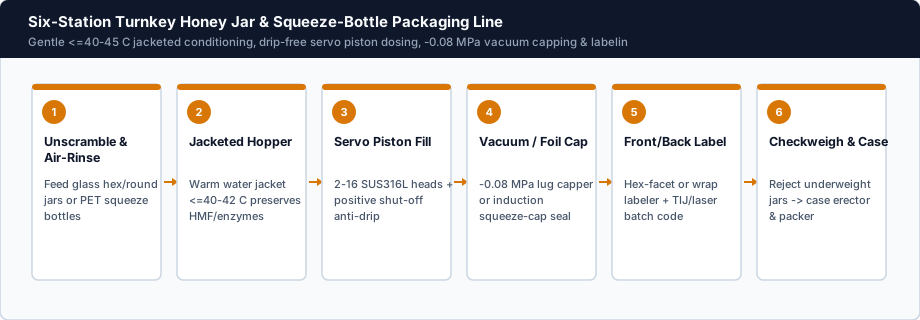
Honey Packaging Engineering Notes
- Refractometer Check on First 5 Jars After CIP: Always check °Brix on the first jars after a wet washdown to confirm zero rinse water remained in manifold low points.
- Lubricate Piston Seals with Food-Grade Glycerin: A light film of USP food-grade glycerin keeps PTFE/FKM piston seals gliding smoothly without sticking after dry storage.
- Inspect Nozzle Tip O-Rings Weekly: Crisp anti-drip cutoff depends on intact PTFE/Viton tip seats—swap worn O-rings in 2 minutes during weekly PM.
Book Your Viscous Sample FAT
Submit your container and viscosity parameters via Project Brief.
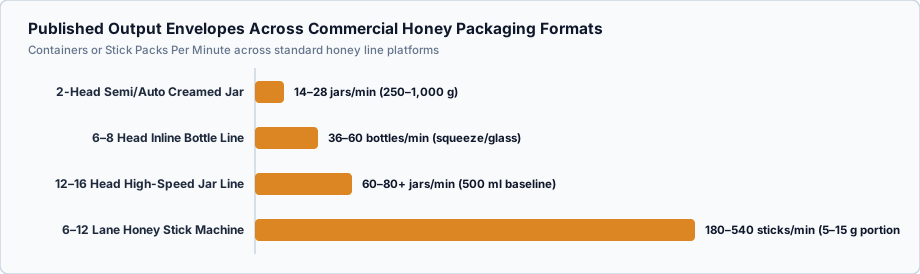
Explore related systems in Honey Packaging Lines, Viscosity & Anti-Drip Specs, or send your jar/stick specs via Project Brief.
Related Specifications
Further Reference
Request Project Configuration Review
Share layout constraints, architectural drawings, or throughput targets with Honey Packaging Line Technical Group.
Configure My Honey Line