Precision Handling for Top-Heavy Inverted PET Bottles & Honey Bears
Retail consumers love inverted no-drip silicone-valve PET squeeze bottles and classic sculpted honey bears—but thin-wall PET tips over easily on conveyors, narrows down to 28–38 mm necks, and leaks in e-commerce transit unless induction-foiled properly. Within honey bottle and jar lines and honey packaging lines, dedicated squeeze-bottle lines pair stabilizing puck/clamp conveyors with clean-rim diving nozzles and air-cooled induction sealers.
Because even a microscopic smear of honey on a PET bottle lip prevents aluminum induction foil from bonding, positive tip-shutoff + suck-back nozzles are mandatory.
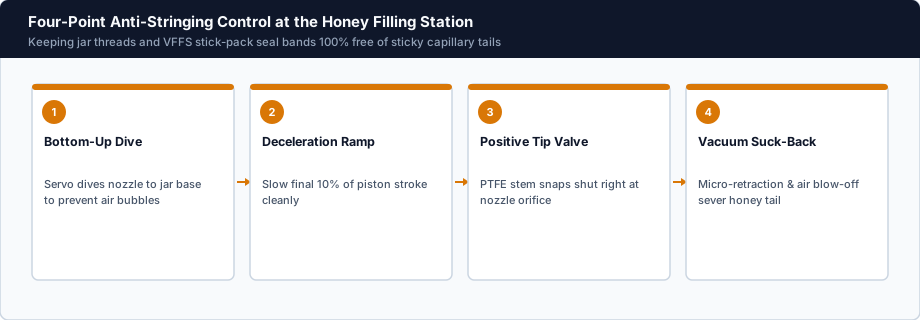
Squeeze Bottle & Honey Bear Engineering Solutions
How dedicated squeeze-bottle lines solve common shop-floor failures:
| Common PET Squeeze Issue | Root Mechanical Cause | Engineered Line Solution |
|---|---|---|
| Leaking Induction Foil Seal | Micro-drop of honey stringing onto PET neck land | PTFE bottom-shutoff nozzle + suck-back + rim check |
| Inverted Bottle Tipping Over | Small cap footprint or light empty honey bear | CNC transport pucks or dual side-gripper belts |
| Crushed / Panelled PET Walls | Filling >48 °C honey then sealing airtight | Fill at <=38–40 °C so headspace doesn’t collapse on cooling |
| Scuffed Flip-Top Hinges | Abrasive rubber spindle wheels chewing soft PP caps | Servo chuck torque capper with custom flip-cap socket |
Compare glass jar vacuum lug systems on glass honey jar vacuum capping lines.
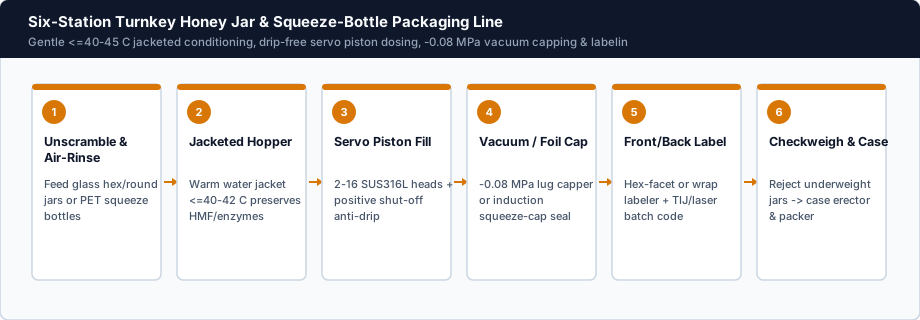
Honey Packaging Engineering Notes
- Missing-Foil & Stall-Bottle Reject: Inline eddy-current foil detectors and tunnel-stall sensors eject unsealed bottles automatically before case packing.
- Front-and-Back Contoured Labeling: Twin wiping brushes conform pressure-sensitive clear ‘no-label-look’ BOPP labels smoothly onto curved squeeze-bottle waists.
- 3-Minute Saved Recipe Recall: Recall saved servo dive profiles, conveyor speeds, and label delays between 250 g bears and 680 g squeeze bottles in ~3 minutes.
Qualify Your Squeeze Bottle & Flip-Cap
Send bottle drawings, cap diameter (e.g., 38-400 flip valve), and target BPM via Project Brief.
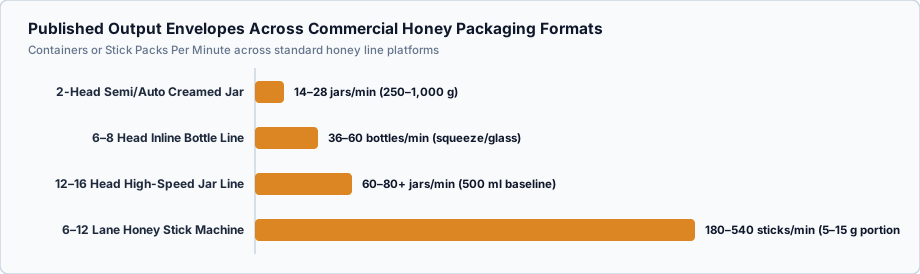
Explore related systems in Honey Packaging Lines, Viscosity & Anti-Drip Specs, or send your jar/stick specs via Project Brief.
Related Specifications
Further Reference
Request Project Configuration Review
Share layout constraints, architectural drawings, or throughput targets with Honey Packaging Line Technical Group.
Configure My Honey Line