Protecting Fine Crystal Structure and Bioactive MGO Potency
Standard liquid honey fillers rely on warming honey to 40 °C so it flows easily—a shortcut that destroys whipped creamed honey (melting its fine Dyce-process glucose seed crystals so it re-sets into coarse, gritty sand) and risks degrading DHA/MGO markers in high-grade Mānuka! Built on honey varietal packaging setups and honey viscosity and nozzle specs, dedicated paste-grade honey fillers move 30,000–90,000 cP honey cold or gently tempered.
Pressurized or auger-assisted conical hoppers feed oversized rotary-plug servo pistons and wide 15–24 mm knife-edge diving nozzles.
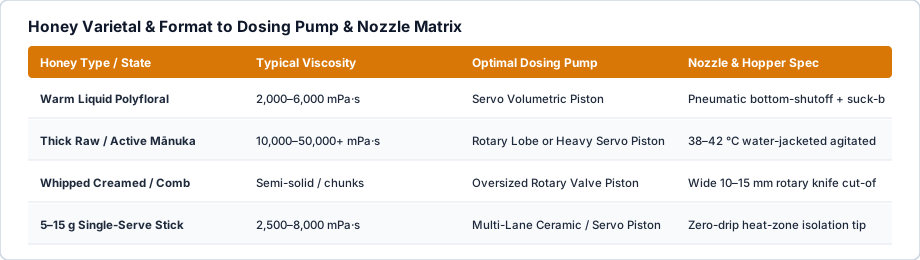
Creamed vs Active Mānuka Line Engineering Controls
Hardware customizations that prevent cavitation, air pockets, and crystal damage:
| Critical Subsystem | Whipped Creamed Honey Spec | UMF / MGO Mānuka Honey Spec |
|---|---|---|
| Hopper Temperature | Unheated or chilled water jacket (20–25 °C) | Precision warm-water jacket strictly <=32–35 °C |
| Hopper Feed Assist | Slow helical wall scraper + positive feed screw | Low-RPM anchor agitator maintains thixotropic fluidity |
| Dosing Mechanism | Wide-bore SUS316L servo piston + rotary shear valve | Servo piston or low-shear sanitary rotary lobe |
| Jar Filling Motion | Synchronized bottom-up dive fills corners void-free | Bottom-up dive + induction foil + serialized tamper seal |
Packing cut-comb chunks or infused varieties? See raw, comb, and honey straw setups.
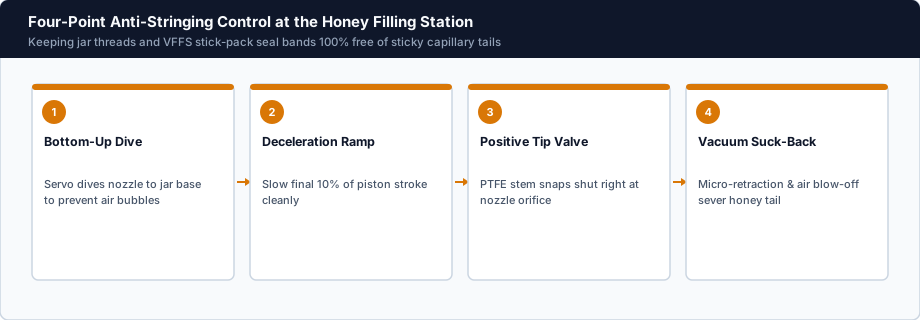
Honey Packaging Engineering Notes
- Eliminate White Frosting / Air Voids in Clear Jars: Filling stiff creamed honey from above traps ugly air pockets against glass walls; servo bottom-up nozzle tracking keeps backpressure steady for smooth jar walls.
- Zero-Dead-Volume Tri-Clamp Valves: Sanitary 3-way rotary valves shear thick paste cleanly without crushing crystal structure.
- Amber PET & Violet Glass Handling: Non-marring guide rails and high-contrast optical sensors handle dark UV-blocking Mānuka jars reliably.
Test Your Creamed or Mānuka Rheology
Share your filling temperature, cP range, and jar mouth diameter via Project Brief.
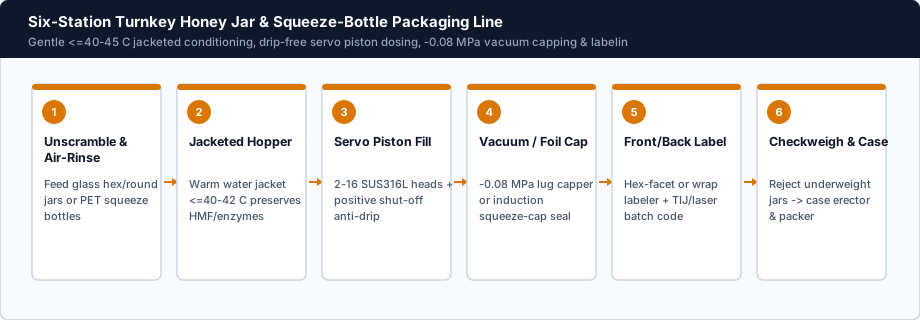
Explore related systems in Honey Packaging Lines, Viscosity & Anti-Drip Specs, or send your jar/stick specs via Project Brief.
Related Specifications
Further Reference
Request Project Configuration Review
Share layout constraints, architectural drawings, or throughput targets with Honey Packaging Line Technical Group.
Configure My Honey Line