Hermetic Button-Down Twist-Off Seals for Premium Glass Honey Jars
Artisanal, organic, and supermarket glass honey jars rely on plastisol-lined metal lug (‘twist-off’) caps with center safety buttons that pop up when first opened. Because honey is filled warm (38 °C) rather than boiling hot (85 °C like jam), natural thermal cooldown alone cannot pull enough headspace vacuum to depress the safety button reliably. Inside honey bottle and jar lines and honey packaging lines, an automatic chamber or steam-free mechanical vacuum capper (JVC-40 class) evacuates headspace to -0.08 MPa before torquing the metal lug cap.
Dry mechanical vacuum capping avoids injecting wet steam onto hygroscopic honey surfaces—keeping surface moisture below 18% so osmophilic yeast fermentation can never start!
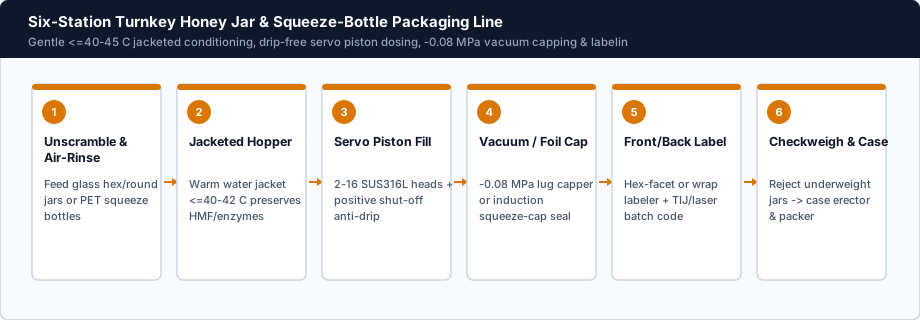
Glass Honey Jar Line Station-by-Station Specifications
Coordinated equipment specs for 125 g to 1,000 g round and hexagonal glass jars:
| Station | Mechanical Function | Key Honey-Specific Parameter |
|---|---|---|
| 1. Rotary Table & Ionized Air Rinse | Unscramble glass jars + invert/blow glass dust | Dry ionized air (zero water droplets inside jar!) |
| 2. 4–12 Head Servo Piston Filler | Bottom-up diving fill from <=40 °C jacketed tank | ±0.2%–0.5% accuracy; zero bubbles; clean jar rim |
| 3. Vibratory Lid Feeder + Vacuum Capper | Evacuate chamber to -0.08 MPa + servo torque | Dry vacuum depresses safety button without steam |
| 4. Shrink Neck-Band + Facet Labeler | Optional tamper sleeve + 1/2/3-panel hex labeler | Facet orientation aligns front/back + top-over-side strap |
Also running inverted plastic squeeze bottles? Compare honey squeeze bottle filling lines.
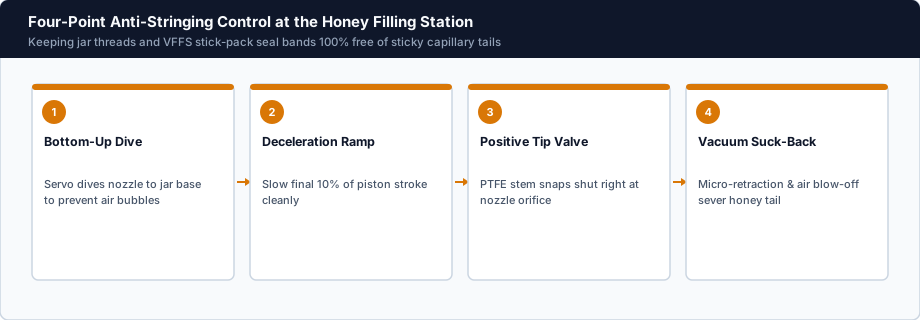
Honey Packaging Engineering Notes
- Why Steam-Flushed Capping Hurts Honey: Steam cappers condense water droplets directly onto the top layer of honey, diluting surface °Brix and triggering yeast fermentation—always specify dry mechanical vacuum capping for honey.
- Lollipop / Tax-Stamp Strap Labeling: Specialized L-strap or U-strap label heads apply tamper-evident origin seals over the cap top and down the glass side facet in one pass.
- Glass Breakage Interlocks: Soft Delrin starwheels and overload torque clutches prevent glass-on-steel shatters along the conveyor.
Send Your Glass Jar & Lug Cap Specs
Share jar height, mouth finish (e.g., 58, 63, 70, 82 mm lug), and BPM via Project Brief.
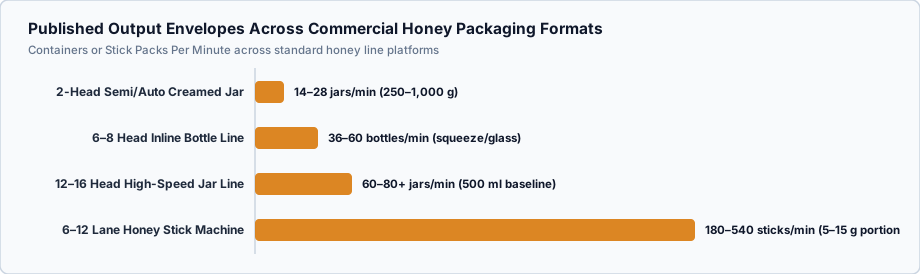
Explore related systems in Honey Packaging Lines, Viscosity & Anti-Drip Specs, or send your jar/stick specs via Project Brief.
Related Specifications
Further Reference
Request Project Configuration Review
Share layout constraints, architectural drawings, or throughput targets with Honey Packaging Line Technical Group.
Configure My Honey Line