Engineering Around Stringing, Crystallization, and HMF Heat Limits
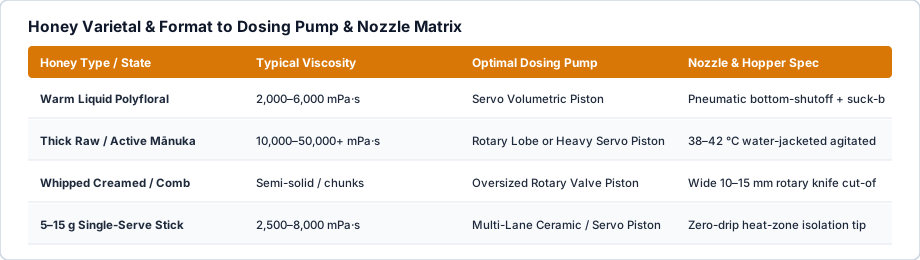
Honey is one of the most deceptive fluids in food packaging: at 78–84 °Brix (17–20% moisture), its viscoelastic capillary stringing fouls ordinary liquid nozzles, cold winter mornings push viscosity past 50,000 mPa·s (cP), and overheating above 45 °C destroys natural diastase enzymes while spiking hydroxymethylfurfural (HMF) past export limits. A purpose-built honey packaging line pairs gentle warm-water-jacketed hoppers (35–42 °C), positive-displacement servo piston or rotary-lobe dosing (±0.2%–0.5%), and positive bottom-shutoff anti-drip nozzles.
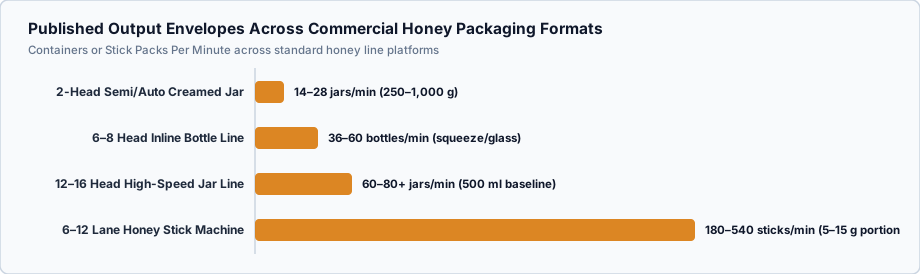
Complete lines scale from 14–28 jars/min compact 2-head setups to 60–80+ jars/min 12–16 head bottling lines and 2-to-12 lane stick-pack systems producing up to 540 single-serve sticks/min.
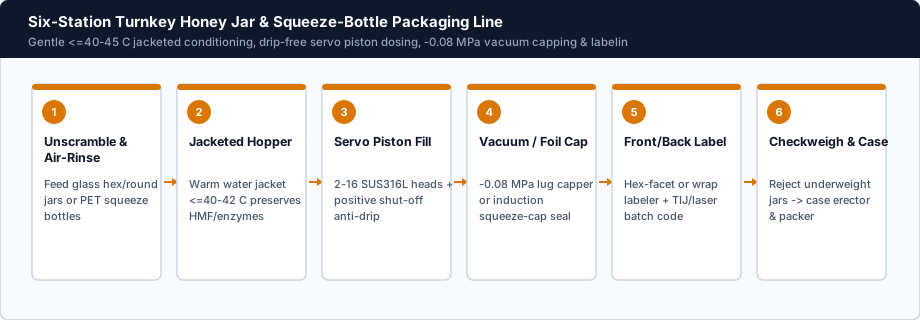
Commercial Honey Packaging Line Architectures
Select your core line architecture by retail format, viscosity state, and target output:
| Retail / Bulk Format | Core Dosing & Sealing Hardware | Container / Pack Range | Published Line Output |
|---|---|---|---|
| Glass Round & Hex Jars | 4–16 Head Servo Piston + -0.08 MPa Vacuum Lug Capper | 100 g – 1,500 g glass jars | 24–80 jars/min |
| PET Inverted Squeeze Bottles | 4–12 Head Diving Piston + Flip-Cap Torque + Induction | 250 g – 1,000 g PET/HDPE | 30–75 bottles/min |
| Single-Serve Stick & Sachet | 2–12 Lane Heated Piston VFFS + Horizontal Cartoner | 5 g – 20 g tubular sticks / sachets | 80–540 packs/min |
| Creamed & Active Mānuka Jars | Low-Shear Rotary Lobe / Wide-Valve Servo Piston | 125 g – 500 g thick paste jars | 20–55 jars/min |
| Spout Pouches & Bakery Pails | Rotary Spout Filler or Net-Weight Platform Filler | 250 g pouches; 5–25 kg pails | 20–45 pouches / 3–8 pails/min |
Explore rigid bottling in honey bottle and jar lines, portion packs in honey stick and pouch machines, and rheology controls in honey viscosity and nozzle specs.
Honey Packaging Engineering Notes
- Zero-Drip Rim Integrity: Positive-shutoff PTFE tip stems with programmable suck-back sever viscous honey tails cleanly so jar threads never glue caps crooked.
- Bubble-Free Bottom-Up Diving: Servo-driven nozzle bars dive to container bottoms and rise with the liquid meniscus—preventing unsightly trapped air bubbles in clear bear or hex jars.
- CIP Sanitary SUS316L Fluid Path: Tri-clamp manifolds, PTFE/FKM seals, and warm-water CIP flushing switch floral varietals without multi-hour teardown.
Three Honey Parameters Lock Your Line Design
Confirm fill temperature (20 °C ambient creamed vs 38–40 °C conditioned liquid), container drawings (neck ID & cap style), and target containers per shift.
Send your specifications via Project Brief or compare floral setups in honey varietal packaging setups.
Explore related systems in Honey Packaging Lines, Viscosity & Anti-Drip Specs, or send your jar/stick specs via Project Brief.
In This Section
Further Reference
Request Project Configuration Review
Share layout constraints, architectural drawings, or throughput targets with Honey Packaging Line Technical Group.
Configure My Honey Line