Why Gravity and Standard Liquid Fillers Fail on Pure Honey
Water (1 cP) stops flowing the instant a pinch valve closes; pure honey (2,000–10,000 mPa·s at 25 °C, climbing past 50,000–100,000 mPa·s when chilled or glucose-crystallized) stretches into elastic threads that bridge across conveyor slats and contaminate heat-seal bands. Across honey packaging lines, clean operation relies on pairing positive-displacement rotary valves with tip-seated cut-off nozzles.
Equally critical is thermal discipline: direct electric band heaters scorch boundary layers, darkening color and raising HMF above Codex Alimentarius 40 mg/kg (or 15 mg/kg raw/low-heat buyer specs). Always specify double-wall warm-water-jacketed hoppers circulating water at 38–42 °C with slow-speed scraper agitation.
Servo Volumetric Piston vs Rotary-Lobe Pump for Honey
Compare the two primary industrial honey dosing mechanisms:
| Engineering Parameter | Servo Volumetric Piston Filler | Servo Rotary-Lobe Pump Filler |
|---|---|---|
| Viscosity Window | 1,000 – 100,000 cP (liquid to thick creamed) | 2,000 – 100,000+ cP (best on uniform viscous) |
| Fill Volume Range | 50 – 5,000 ml (cylinder matched to SKU) | 100 ml – 25 kg continuous metered |
| Dosing Accuracy | ±0.2% – ±0.5% (0.1 mm servo ball-screw stroke) | ±0.5% – ±0.8% (requires stable inlet head) |
| Particulate / Comb Tolerance | High with oversized 3-way rotary plug valve | Low-shear lobes; avoid hard wax >8 mm |
| CIP & Varietal Changeover | Fast tri-clamp cylinder rinse or CIP loop | True inline CIP forward-flush without disassembly |
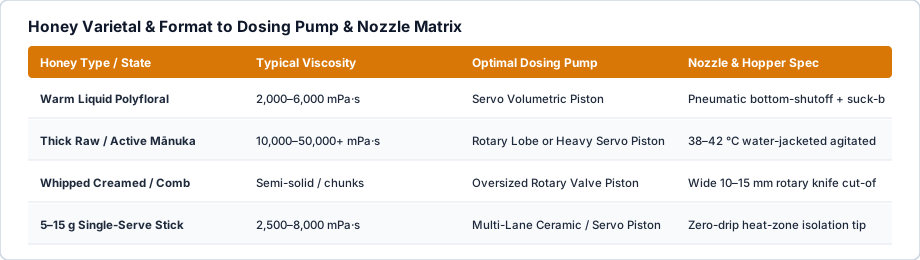
Check your honey varietal temperature-viscosity pairing on our honey viscosity and nozzle chart.
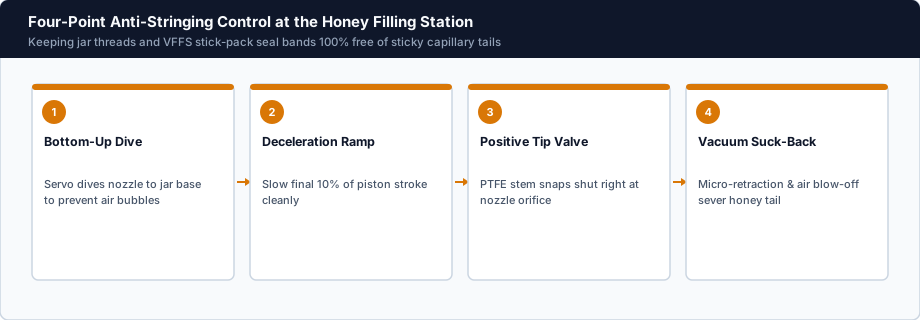
Honey Packaging Engineering Notes
- Match Nozzle Bore (3–12 mm) to Neck Opening: Use 3–5 mm nozzles on stick packs/vials, 8–12 mm diving nozzles on 28–38 mm squeeze necks, and 14–22 mm wide-port cutoffs on wide-mouth 500 g jars.
- SUS316L + Food-Grade PTFE/FKM Seals: Honey is mildly acidic (pH 3.4–6.1) and abrasive when micro-crystallized—specify SUS316L product contact and wear-resistant PTFE piston rings.
- Heated Flexible Hose & Manifold Tracing: Insulate or warm-trace the manifold between hopper and nozzles so the first 10 jars after a lunch break never under-fill from cold-thickened plugs.
Match Pump & Nozzle to Your Exact °Brix
Explore application guides in honey varietal packaging setups and sizing math in honey line sizing and selection.
Submit your honey moisture %, fill temp, and jar neck ID via Project Brief.
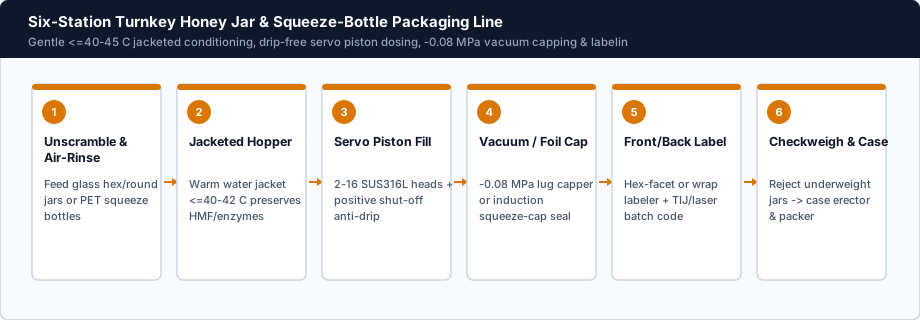
Explore related systems in Honey Packaging Lines, Viscosity & Anti-Drip Specs, or send your jar/stick specs via Project Brief.
In This Section
Further Reference
Request Project Configuration Review
Share layout constraints, architectural drawings, or throughput targets with Honey Packaging Line Technical Group.
Configure My Honey Line