Six Engineering Checks That Guarantee Drip-Free Honey Runs
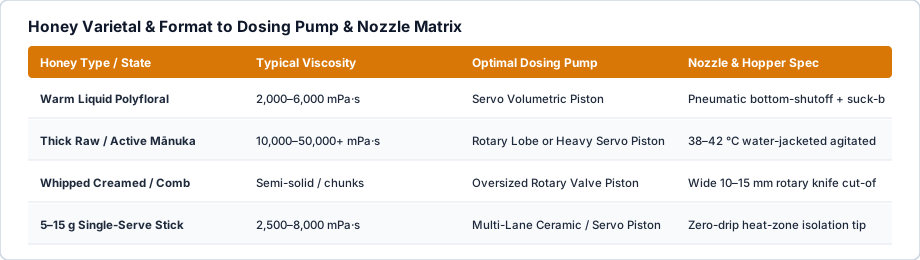
Every frustrating honey bottling story traces back to one of six oversights: gravity/overflow nozzles bought by mistake, live-steam HMF scorching, steam-capper moisture fermentation, un-dived foam bubbles, or sticky PET lips failing induction foil tests. Grounded in honey line sizing and selection and honey viscosity and nozzle specs, verify all six items before signing an equipment order.
Use this table when comparing quotes across candidate manufacturers.
Six-Step Honey Line Specification Audit
Non-negotiable hardware specifications for commercial honey lines:
| Audit Step | Wrong Generic Spec (Reject) | Correct Honey-Grade Spec (Approve) |
|---|---|---|
| 1. Dosing Principle | Gravity, time-pressure, or overflow filler | Servo volumetric piston (rotary plug) or sanitary rotary lobe |
| 2. Hopper Conditioning | Single-wall bare steel or electric band heater | Double-wall warm-water jacket (35–42 °C PID) + slow scraper |
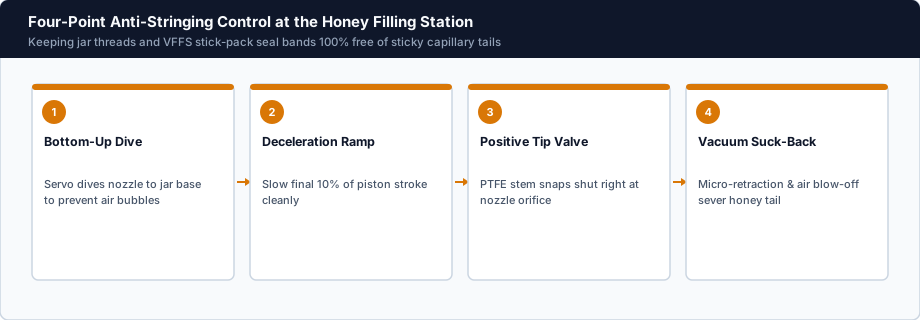
| 3. Nozzle Shut-Off | Open tube or upper check valve (drips tails) | Bottom-seated PTFE tip shut-off + suck-back + servo dive |
| 4. Glass Lug Capping | Wet steam-flush capper (dilutes honey °Brix) | Dry mechanical chamber vacuum capper (-0.08 MPa) |
| 5. PET Squeeze Closure | Loose unlined flip-cap (leaks in transit) | Clean-rim fill + servo torque + air-cooled induction foil |
| 6. Wetted Sanitation | Threaded galvanized/304 fittings with dead legs | Tri-clamp SUS316L manifold + DN50 wide suction port |
Verify all six during pre-shipment testing with our honey line FAT and CIP checklist.
Honey Packaging Engineering Notes
- Convert Grams to Milliliters Properly: Remember
ml = grams ÷ 1.42when checking whether a 500 ml cylinder handles your 680 g jar (479 ml= yes!) or 750 g jar (528 ml= needs 1,000 ml cylinder). - Plan Varietal Changeover Time: If switching from dark buckwheat honey to pale acacia honey daily, specify CIP-ready tri-clamp manifolds and spare piston seal sets.
- Check Compressed Air Dew Point: Dry 0.6 MPa air ensures crisp millisecond actuation on pneumatic anti-drip nozzle stems.
Have Our Engineers Review Your Bottle & Honey Specs
Share your SKU list via Project Brief.
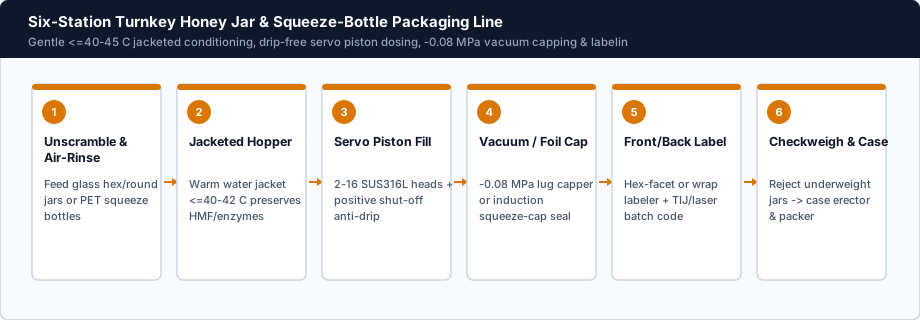
Explore related systems in Honey Packaging Lines, Viscosity & Anti-Drip Specs, or send your jar/stick specs via Project Brief.
Related Specifications
Further Reference
Request Project Configuration Review
Share layout constraints, architectural drawings, or throughput targets with Honey Packaging Line Technical Group.
Configure My Honey Line