Why Varietal Rheology Breaks One-Size-Fits-All Honey Fillers
Two jars labeled ‘Pure Honey’ behave like completely different materials inside a pump manifold: liquid clover honey is pseudoplastic (3,000–6,000 cP), active UMF/MGO Mānuka honey is strongly thixotropic (gel-like at rest above 30,000–60,000 cP, thinning only under gentle shear), and whipped creamed honey loses its velvety fine-crystal structure permanently if warmed above 28–30 °C! Grounded in honey viscosity and nozzle specs, each varietal demands specific hopper conditioning and valve geometry.
Explore high-viscosity configurations in creamed and Mānuka honey filling lines and artisan/specialty formats in raw, comb, and honey straw setups.
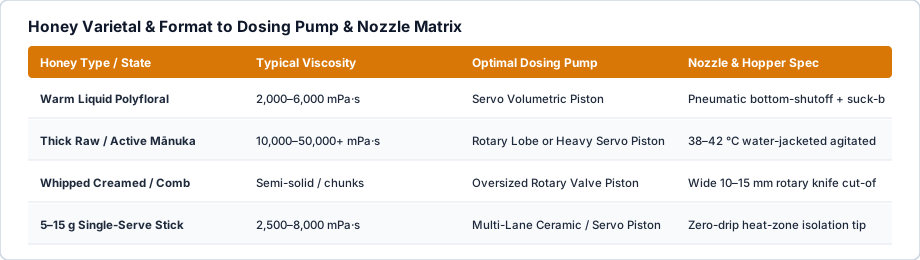
Varietal Thermal & Shear Constraints Matrix
Critical temperature ceilings and pump rules across high-value honey styles:
| Honey Varietal | Max Safe Hopper Temp | Recommended Pump & Feed | Key Quality Risk to Prevent |
|---|---|---|---|
| UMF / MGO Active Mānuka | 32–36 °C gentle water jacket | Agitated pressurized hopper + servo lobe/piston | Methylglyoxal (MGO) / DHA degradation & air pockets |
| Whipped Creamed / Spun Honey | 20–26 °C (NEVER melt crystals) | Positive-feed auger hopper + wide rotary-valve piston | Melting seed crystals ruins spreadable texture |
| Raw Unpasteurized Floral | <= 38–40 °C max | 300–600 μm inline strainer + diving servo piston | Preserves natural pollen, diastase >=8 & low HMF |
| Chili / Ginger / Nut Infused | 35–42 °C continuously stirred | Agitated hopper + particulate rotary plug valve | Stops spice sedimentation or crushed nut pieces |
Size your line speed in honey line sizing and selection.
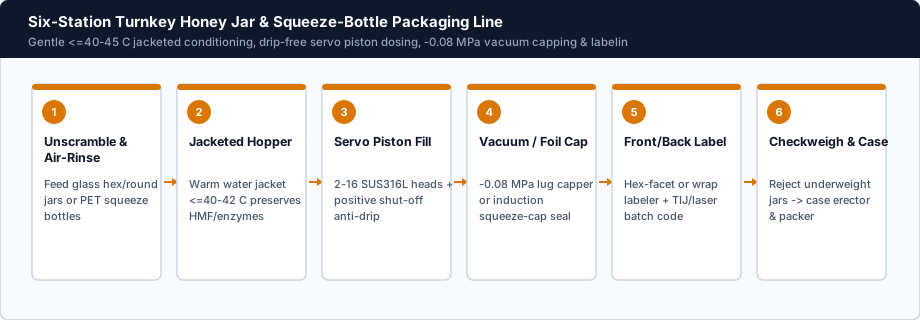
Honey Packaging Engineering Notes
- Positive Hopper Head Pressure for Creamed Honey: Stiff creamed honey will cavitate gravity suction tubes—specify a conical hopper with slow helical wall-scraper blades or pneumatic follower plate.
- Tamper-Evident Security for High-Value Mānuka: Combine induction foil liners, neck tamper bands, and serialized QR/NFC cap labels on $40–$120 Mānuka jars.
- Zero Dead-Leg Sanitary Piping: Eliminate stagnant pipe tees where seeded glucose crystals nucleate and trigger premature crystallization across the next liquid batch.
Qualify Your Varietal Rheology
Share your honey varietal, fill temperature, and jar weight via Project Brief.
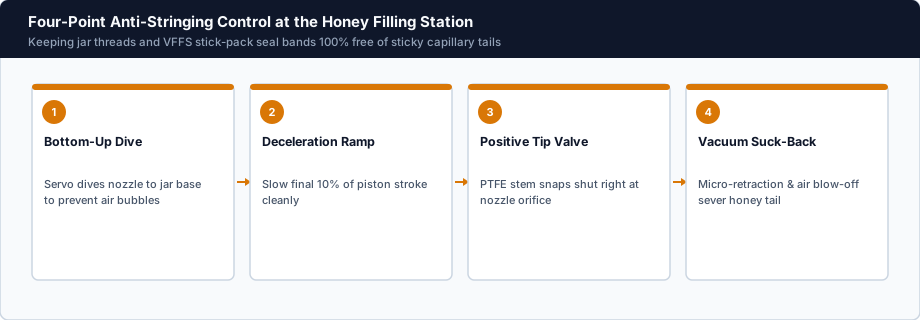
Explore related systems in Honey Packaging Lines, Viscosity & Anti-Drip Specs, or send your jar/stick specs via Project Brief.
In This Section
Related Specifications
Further Reference
Request Project Configuration Review
Share layout constraints, architectural drawings, or throughput targets with Honey Packaging Line Technical Group.
Configure My Honey Line