Sizing Around Honey’s Specific Gravity (1.42) and Suction Cycle Time
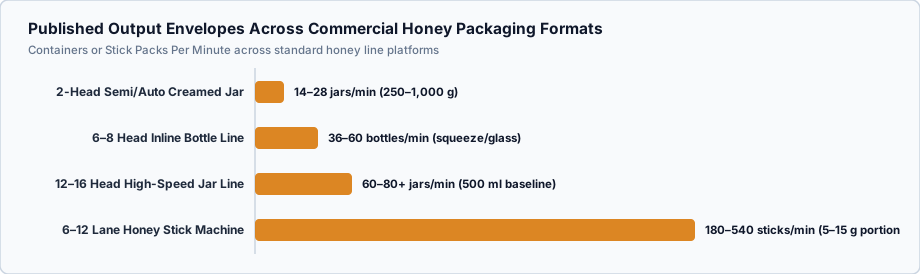
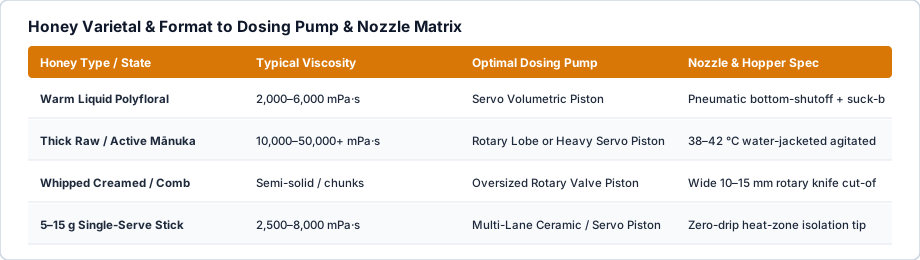
A critical math detail catches first-time honey bottlers off guard: honey has a specific gravity of ~1.41–1.43 g/ml—meaning a ‘500 g honey jar’ holds only ~352 ml by volume, whereas a ‘500 ml jar’ weighs ~710 g! Furthermore, drawing 35,000 cP cold honey into a piston cylinder takes 2–3× longer than drawing water unless suction ports and cylinder bores are sized properly. Built on honey viscosity and nozzle specs, use our calculators and guides to lock exact specs.
Run head-count math in the honey line BPM and piston calculator and viscosity to nozzle bore chart, then read honey packaging line cost, how to choose a honey filling machine, and our honey line FAT & CIP checklist.
Honey Weight-to-Volume & Piston Cylinder Sizing Table
Using standard pure honey density (1.42 g/ml at 18% moisture):
| Label Net Weight | Actual Fluid Volume (ml) | Ideal Servo Piston Cylinder | Typical Cycles / Min / Head |
|---|---|---|---|
| 10 g Honey Stick | ~7.0 ml | 5–30 ml multi-lane ceramic/SS piston | 35–45 cycles/min/lane |
| 250 g Retail Jar / Bear | ~176 ml | 50–500 ml servo cylinder | 12–16 cycles/min/head |
| 340 g (12 oz) Squeeze Bottle | ~239 ml | 50–500 ml servo cylinder | 11–15 cycles/min/head |
| 500 g Standard Jar | ~352 ml | 100–1,000 ml servo cylinder | 10–13 cycles/min/head |
| 1,000 g (1 kg) Family Tub | ~704 ml | 100–1,000 ml servo cylinder | 7–10 cycles/min/head |
Explore matching bottling hardware in honey packaging lines.
Honey Packaging Engineering Notes
- Suction Stroke Governs Cycle Speed: On viscous honey, piston draw speed must stay below cavitation threshold so vacuum voids never form inside the metering cylinder.
- Oversize Sanitary Supply Piping (DN50 / 2-inch): Narrow 1-inch inlet hoses choke 8-head fillers—specify short, insulated 51–63 mm (2–2.5 inch) sanitary tri-clamp suction manifolds.
- Account for Batch Tank Settling: Allow de-aeration settling time in jacketed holding tanks after pumping from 300 kg drums so micro-bubbles rise before filling.
Verify Your Jar Volume & Shift BPM
Send your jar net grams, moisture %, and daily case target via Project Brief.
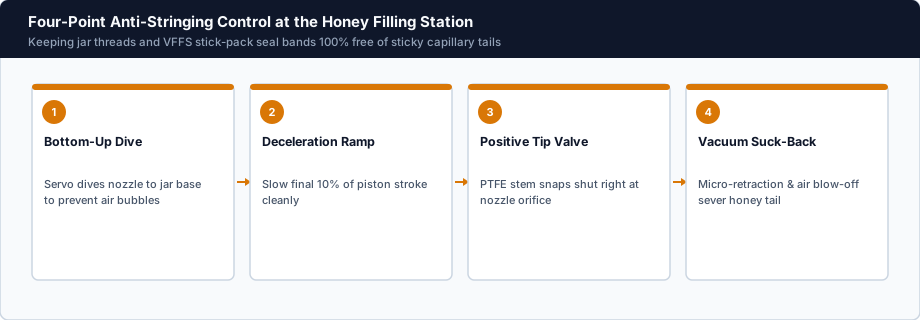
Explore related systems in Honey Packaging Lines, Viscosity & Anti-Drip Specs, or send your jar/stick specs via Project Brief.
In This Section
- Honey Packaging Line BPM & Piston Filler Head-Count Calculator
- Honey Temperature-to-Viscosity, Nozzle Bore & Suction Pipe Sizing Chart
- Honey Filling Machine & Turnkey Bottling Line Price Guide
- How to Choose a Honey Filling Machine & Bottling Line
- Factory Acceptance Test (FAT) & CIP Cleaning Protocol for Honey Lines
Related Specifications
Further Reference
- Honey Rheology, <=42 °C Jacketed Tanks & Anti-Drip Nozzle Engineering
- Honey Packaging Line BPM & Piston Filler Head-Count Calculator
- Honey Temperature-to-Viscosity, Nozzle Bore & Suction Pipe Sizing Chart
- Honey Filling Machine & Turnkey Bottling Line Price Guide
- How to Choose a Honey Filling Machine & Bottling Line
Request Project Configuration Review
Share layout constraints, architectural drawings, or throughput targets with Honey Packaging Line Technical Group.
Configure My Honey Line